

If you have ever stood in a nursery or scrolled through a plant group online and wondered which Adenium you are actually looking at, you are not alone. Most of us started the same way. We saw a beautiful desert rose, bought it, brought it home, and then spent weeks trying to figure out exactly what species it was.
The good news is that the leaves tell you almost everything you need to know. Once you train your eye to notice a few simple things, identifying Adenium species becomes surprisingly easy and even a little addictive.
Why Leaves Are the Best Starting Point
When an Adenium is not in bloom, the flowers cannot help you. The caudex shape can give you some clues but it takes years to develop a distinctive form. The leaves however are always there, always visible, and each species has its own personality when it comes to leaf shape, size, texture, and color.
You do not need any special tools. Just your eyes and a little knowledge.
The Five Common Adenium Species and Their Leaves
Adenium Obesum
This is the one most people start with and for good reason. The leaves of Adenium Obesum are medium sized, slightly elongated, and have a soft rounded tip. They are not too narrow and not too wide. The surface is smooth and glossy and the color is a rich deep green.
If the leaf feels firm and looks like a classic oval with a gentle point at the end, you are most likely looking at an Obesum. This is the most common desert rose in nurseries across India and worldwide.
Adenium Arabicum
Arabicum leaves are noticeably rounder and wider than Obesum. When you place them side by side the difference is quite clear. The Arabicum leaf almost looks like a small rounded paddle. The texture is slightly thicker and the surface can look a little more matte compared to Obesum.
Arabicum also tends to have a lighter green color in some growing conditions. If the leaf looks almost circular and feels sturdy and thick in your hand, Arabicum is a strong guess.
Adenium Arabicum Híbrido
This is a hybrid and the leaves reflect that mixed background beautifully. The Arabicum Híbrido leaf is rounder and fuller than a standard Arabicum but often has a slightly deeper and shinier green surface. The size tends to be larger overall.
The easiest way to separate Híbrido from pure Arabicum is to look at the glossiness. Híbrido leaves tend to have a more polished look, almost like someone buffed them gently. The veins are also more prominent and visible when you hold the leaf up to light.
Adenium Swazicum
Swazicum is one of the easiest species to identify because its leaves look nothing like the others. They are long, very narrow, and taper to a sharp point at the tip. Think of a slim blade of grass but thicker and more substantial.
The color is usually a lighter and more yellow green compared to the deep greens of Obesum and Arabicum. If you see a desert rose with leaves that look almost like narrow willow leaves, it is almost certainly a Swazicum. This species is rarer but very distinctive once you have seen it even once.
Adenium Somalense
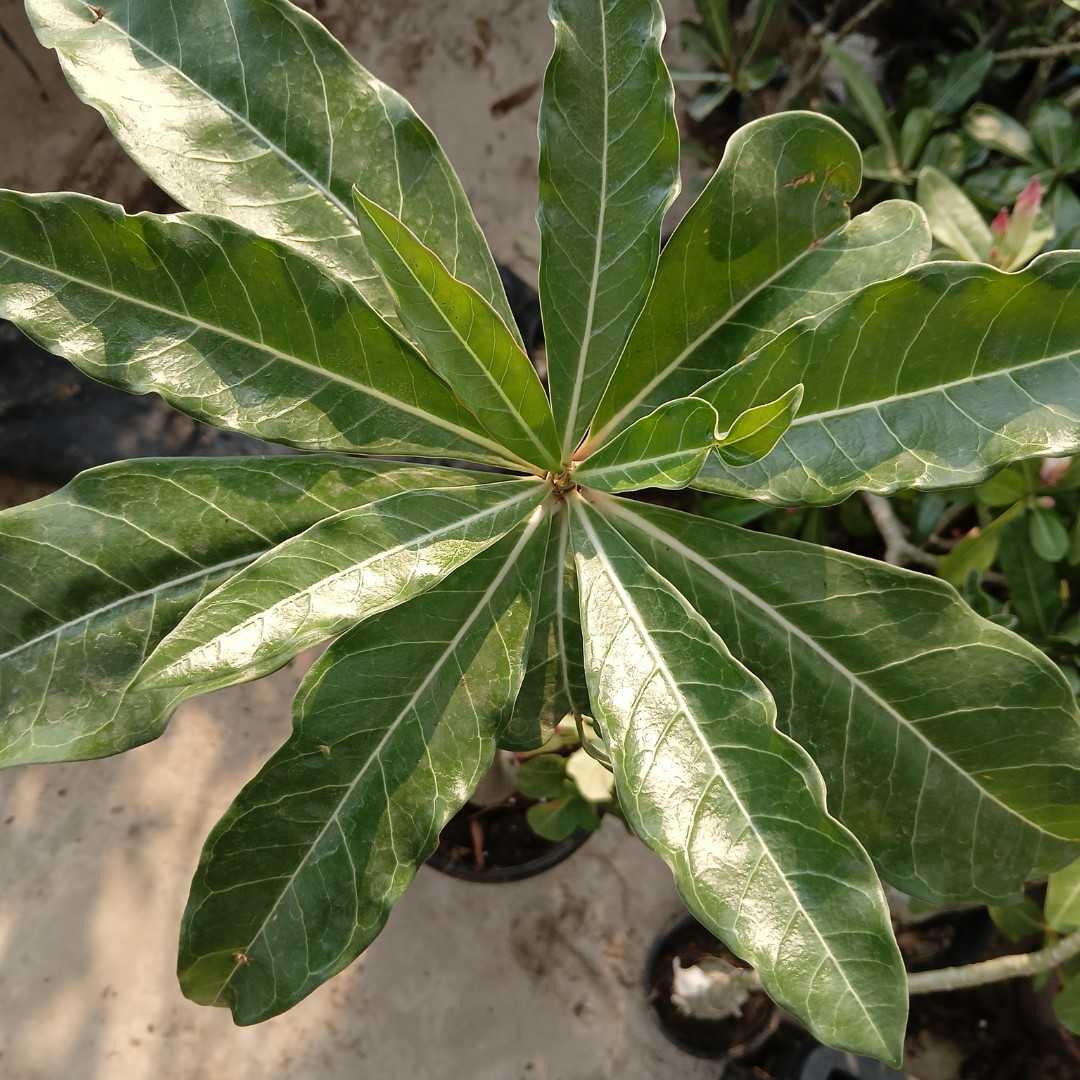
Somalense sits between Swazicum and Obesum in terms of leaf shape. The leaves are long and lance shaped but wider than Swazicum and much longer than Obesum. They taper gently toward both ends giving the leaf an elegant and elongated look.
The surface is smooth and the midrib vein running down the center is very clear and prominent. Somalense leaves feel slightly thinner than Arabicum leaves and the overall impression is of a graceful and refined plant. If the leaf is long, pointed at both ends, and has a clear central vein, Somalense is your answer.
A Quick Comparison to Remember
- Obesum leaves are medium, oval, and glossy with a soft tip.
- Arabicum leaves are round, wide, thick, and slightly matte.
- Arabicum Híbrido leaves are large, round, and very glossy with visible veins.
- Swazicum leaves are very narrow, long, and light green almost like a blade.
- Somalense leaves are long, lance shaped, and elegant with a strong central vein.
Simple Tips for Leaf Identification at Home
- Pick one leaf and lay it flat on a white surface. This helps you see the true shape without distraction.
- Look at the tip first. Is it round, pointed, or very sharp? This alone can narrow things down quickly.
- Feel the texture. Thick and stiff usually points to Arabicum. Thin and smooth often means Somalense or Swazicum.
- Check the color in natural light. Swazicum tends to be lighter while Obesum and Arabicum are darker greens.
- Look at the size relative to your hand. Arabicum Híbrido leaves are often the largest of the common species.
One Last Thing
Identifying Adenium by leaf takes a little practice but it gets faster every time. The more plants you see and touch the quicker your eye adjusts. Start with the species you already own, study the leaves closely, and then compare when you visit a nursery or browse plant groups online.
Your leaves are already trying to tell you their story. You just have to learn to listen.
